
Hackers can now easily access
personal information that people willingly put out onto the Web. People can put their thoughts out into the
world in the span of a nanosecond.
Sensitive information and unpopular opinions can spread at a rapid pace with
little to no control. Social media is a
whole new world and that presents whole new dangers. In order properly practice and work within
social media, you must learn how you can protect yourself and your
organization.
Eight Tips to Keeping Safe
Here are eight major considerations
one must take into account when dealing with social media privacy and policy:
- Always be aware of your privacy settings: Social networking sites such as Facebook are constantly changing their privacy policies. You must keep on top of these security changes and track what your privacy and security settings look like in order to protect the information you share with friends and family from strangers and potential identity thieves. ZDNet offers a helpful guide on how to properly lock down your privacy and security settings on Facebook by walking the user through “a crucial focus area of Facebook's settings, and will run through every single setting, option and feature available to users, to ensure that your privacy is as protected as it can be.” (Whittaker, 2011)
- Avoid specificity: Social media is designed to share what you are doing, where you are doing it, and who you are doing it with. However, this can be cat nip to potential identity thieves looking for whatever clues they can find about you through your social media accounts. Avoiding specifics about your personal information, your daily schedule, and different aspects of your life can better protect you from those looking to exploit you.

- Know what you are clicking on: Link shortening sites such as Bit.ly are useful, especially with the rising importance of micro-blogging. However, these tools can often obfuscate the link’s final destination. Hackers can exploit an innocent click, planting viruses or malware on your organization’s computer systems. Always exercise caution and always know where you are clicking to.
- Always pay attention to changes in the social media space: New and exciting social media tools are being invented and popularized almost every day. The social media user must always be aware of these emerging technologies and how they can be used against you and your organization. Always be aware of how these new tools gather and disseminate your information and act cautiously.
- Every organization is different. What may have been allowable in one office may not be allowable at your next. Knowing your specific organization’s social media policy (what is right or wrong, what is considered proper and improper communication) will help you avoid a lot of headaches and trouble in the future.

- Just because your organization allows it, doesn’t mean you should be doing it: “The NLRB takes the position that broad policies that substantially limit social media communications may violate Section 7 of the National Labor Relations Act (NLRA), which protects an employee’s right to engage in concerted activities for the purpose of mutual aid and protection” (Collins, 2012). Just because the NLRB takes this position does not mean you should feel free to share whatever you want to the world. Always exercise caution about what you are saying because it could harshly effect your work environment later on.
- Know who you are speaking to: As with everything communications: know your audience. But in this specific context, be very aware of who you are speaking with, how they will take your content, and how that can affect you personally and professionally. A funny joke to you and your friends may be considered offensive or disturbing to your co-workers and the public at large.
- Post as if you are speaking in a public square: If it’s not something you would say loudly in public, it’s probably best not to say it at all. This can often be hard to understand when you are sitting by yourself in front of your computer or hand held device. Social media presents itself as a bit of false intimacy, like a small conversation with friends, when it is really a large megaphone to the world.
What
Privacy?
We are living our entire lives on the social web and
an effect of that is our information and private opinions are up for grabs by
anyone willing to listen. While this can
be a great connective tool, the dangers are too great. It is up to the user what they decide to
share and how they share it. The
responsibility lies with you.
This is an aspect of today’s digital culture that is
going under recognized. That is why it
is vital for an organization to have a strong social media policy that can
enforce and guide what is acceptable. As
an employee, everything we do can reflect on the organization we
represent. It’s not just thieves and
hackers we have to worry about, it’s ourselves.
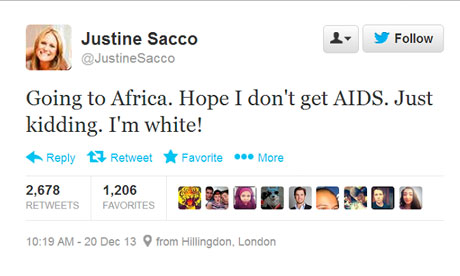
The story of Justine Sacco is just such a case. The ex-PR exec shared an inappropriate joke about AIDS and Africa
and the company she worked for ‘parted ways’ with her. In the aftermath, they issued the following
statement:
“The offensive comment does not reflect the views and values of IAC. We take this issue very seriously, and we have parted ways with the employee in question. There is no excuse for the hateful statements that have been made and we condemn them unequivocally. We hope, however, that time and action, and the forgiving human spirit, will not result in the wholesale condemnation of an individual who we have otherwise known to be a decent person at core."
Proper social media training on the core principles
and policies for the company could have avoided such a situation. As the NLRB has clarified “individual
employee rants…are not protected under the [National Labor Relations Act]…employees
may be disciplined or terminated for engaging in such public rants” (Halpern &
Gardner, 2012). We are putting too much of our lives on the
web and each of the points I’ve listed above can help in stemming that tide,
protecting ourselves from digital thieves, hackers, and even
ourselves.
Do you think we as a culture are over-sharing or is
it just certain groups and people that are guilty of it? How can we lessen what we put of ourselves
online or is already too late?
References
Collins, J. M. (2012, February 01). NRLB Report:
Employers' Social Media Policies Must be Narrow, Must not Restrict Right to
Engage in Protected Activities. Retrieved from The National Law Review:
http://www.natlawreview.com/article/nrlb-report-employers-social-media-policies-must-be-narrow-must-not-restrict-right-t
Halpern, S. J., & Gardner, C. H. (2012, December
03). When is Your Company’s Social Media Policy an Unfair Labor Practice?
Recent NLRB Decisions Offer Long-Awaited Guidance for Employers. Retrieved
from National Law Review:
http://www.natlawreview.com/article/when-your-company-s-social-media-policy-unfair-labor-practice-recent-nlrb-decisions-
Stelter, B. (2013, December 22). 'Ashamed': Ex-PR
exec Justine Sacco apologizes for AIDS in Africa tweet. Retrieved from
CNN: http://www.cnn.com/2013/12/22/world/sacco-offensive-tweet/
Whittaker, Z. (2011, September 4). September 2011:
The Definitive Facebook Lockdown Guide. Retrieved from ZDNet:http://www.zdnet.com/blog/igeneration/september-2011-the-definitive-facebook-lockdown-guide/12641
